Dressing a Rectangle Body Over 50: Simple Ways to Create Definition
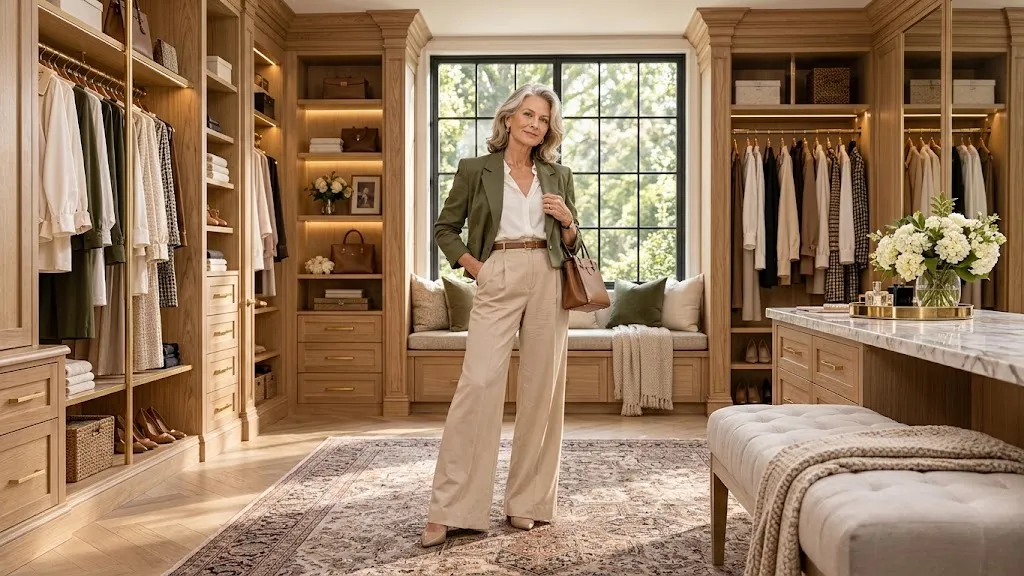
A rectangle shape can leave an outfit looking straighter than you planned, even when each piece fits you well. Tops sometimes drop from shoulder to hip with little shape, and loose layers can make your whole look feel heavier or boxier than it really is.
Styling a rectangle body over 50 doesn’t have to be complicated.That gets frustrating after 50, when all you want is a little definition — without squeezing into tight clothes or chasing some brand-new silhouette.
Here’s the good news: you don’t need a tiny waist or stiff, restrictive clothing to create shape. Small shifts in proportion, fabric, layering, and where each piece visually ends can make an outfit feel far more balanced.
And the goal was never to change your body. It’s to give your clothes better structure around it.
Why a Rectangle Shape Sometimes Looks Straighter in Some Outfits
Why a Rectangle Shape Sometimes Looks Straighter in Some Outfits
With a rectangle shape, the shoulders, waist, and hips often measure fairly close to each other. That doesn’t mean you have to fake dramatic curves.
Trouble usually starts when your clothing copies that same straight line.
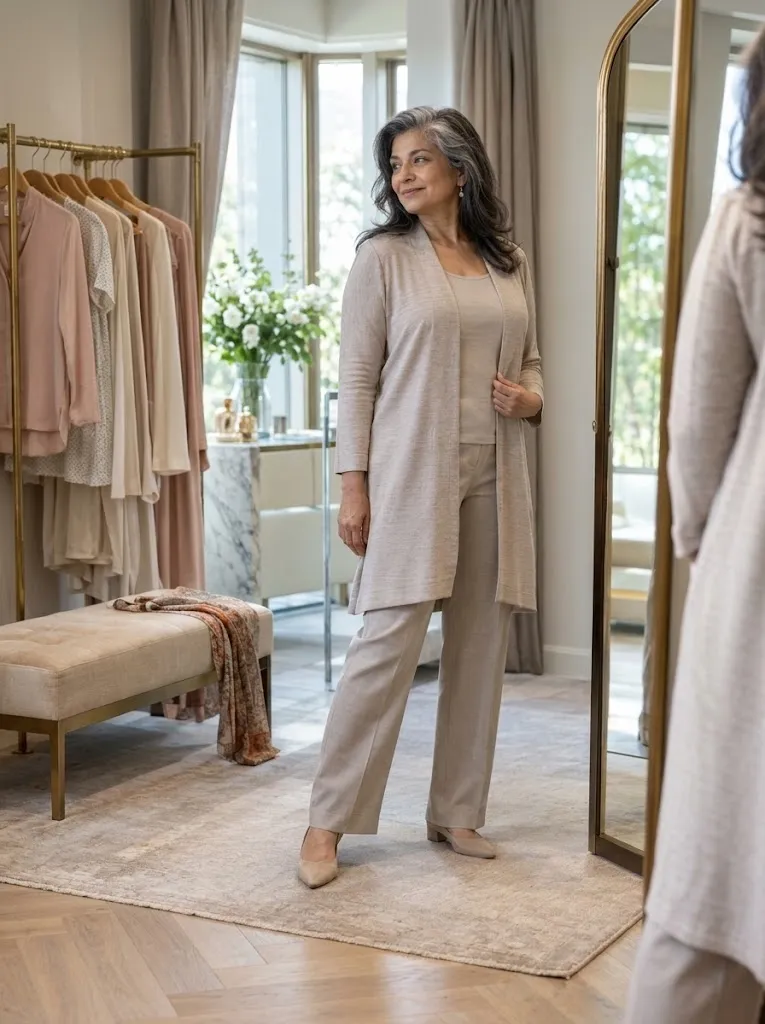
Picture a long, loose sweater worn with straight trousers: you get one solid column from shoulder to ankle. Add a flat shoe and barely any contrast between top and bottom, and the whole silhouette reads more rectangular than you’d like.
Most of the time, contrast is the fix.
You can build it with a shorter jacket, a gently marked waist, a fuller trouser leg, an open neckline, or even a color change between your top half and bottom half.
That trick works beautifully for stylish outfits for women over 50, because you keep all the comfort while the outfit starts to look deliberate.
Build Shape With Contrast, Not Tight Clothes

Build Shape With Contrast, Not Tight Clothes
Defining your waist doesn’t have to mean cinching something tight around your middle.
More often, the most flattering move is simply hinting at where your waist sits while the fabric skims past your body.
A tucked blouse with wider trousers defines you because the top stops cleanly at the waist while the trousers add fullness below. A cropped jacket does the same job for the same reason.
Fabric choice matters every bit as much as the cut.
Very stiff material can build a box around your torso. Super-thin fabric may cling where you’d rather it glide. Hunt for fabrics with enough weight to hold their shape yet enough give to follow your body.
Here’s a quick guide to judging everyday pieces for a rectangle shape.
| Garment | What Works Best | Why It Helps |
|---|---|---|
| Blouse | Soft drape plus a little structure at the shoulder | Shapes you without hugging the waist |
| Knitwear | Fine or medium knit instead of very chunky yarn | Stops the torso from turning into one big block |
| Blazer | Gentle shaping at the waist or a shorter hem | Breaks up a straight shoulder-to-hip line |
| Trousers | Pleats, wider legs, or softly shaped hips | Adds visual width below the waist |
| Dress Fabric | Fluid crepe, soft jersey, cotton blends | Moves with you while keeping some definition |
Fit note: before you decide a garment is wrong for your shape, check where its hem lands. A lovely jacket that stops right at the widest part of your hip can look completely different from one that ends a touch above or below it.
Let Tops and Jackets Mark Your Waistline
Let Tops and Jackets Mark Your Waistline
Your top half usually does the heavy lifting when you’re creating definition.
A top that just hangs off your shoulders can make your torso look straighter. Instead, reach for pieces that create a little shift between shoulder, waist, and hip.
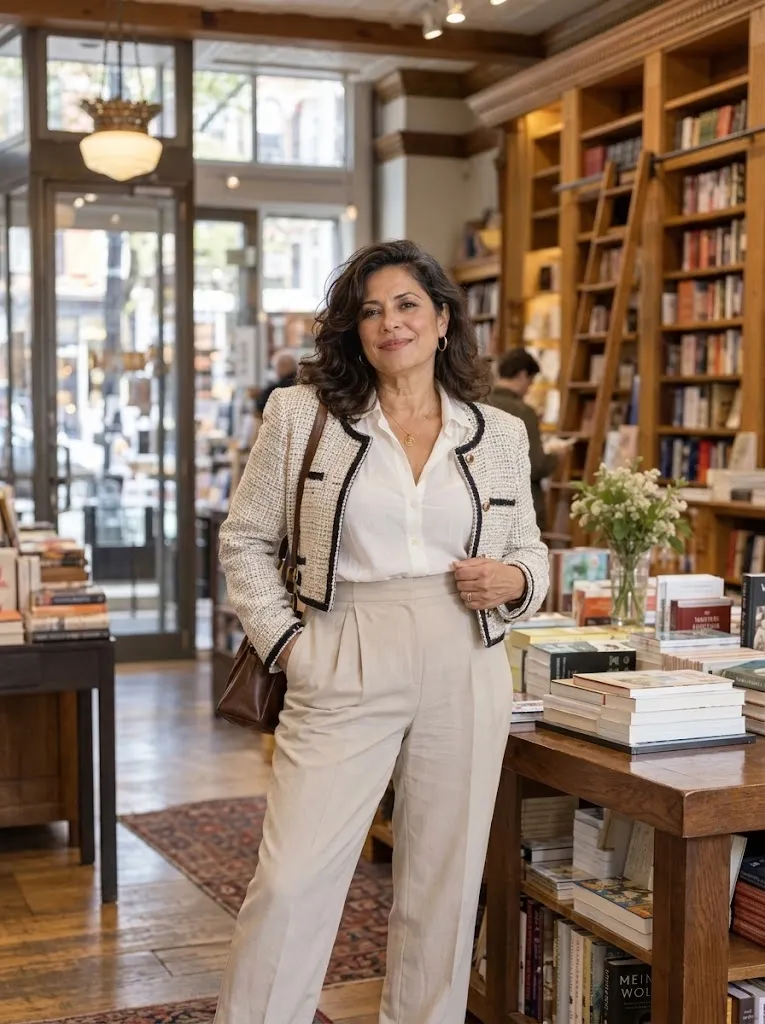
A blouse with a soft tuck is one of the simplest options. You don’t need a strict, full tuck — a relaxed front tuck is often enough to show where your waistband sits.
Shorter jackets can work wonders too.
A blazer that ends around the high hip typically gives more definition than a big, oversized jacket that drops way below it. Light waist shaping, curved seams, or a single-button close can add structure without looking formal.
Open necklines help as well.
A V-neck, gentle scoop, open collar, or half-unbuttoned shirt opens up vertical space through your upper body. That keeps things from looking square and pulls the eye inward.
If longer tops are more your speed, keep shape somewhere else. Try slimmer sleeves, a side slit, a curved hem, or trousers with extra volume underneath.
The principle is simple: don’t let every piece of the outfit draw the same straight line.
Give Your Lower Half a Styling Job Too

Give Your Lower Half a Styling Job Too
Straight-leg trousers are solid wardrobe staples, but they’re far from your only choice.
If you’d like more visible difference between your waist and hips, bottoms with a bit of volume can handle a lot of the styling for you.
Try:
- Wide-leg trousers with a defined waistband and a tucked knit.
- Softly pleated pants that move around the hip.
- Bootcut jeans that add gentle shape below the knee.
- A-line skirts that drift outward softly from the waist.
- Bias-cut skirts when you want an easier, more fluid line.
You don’t need big, dramatic volume.
Even a trouser leg that widens just slightly from the hip can shift the whole balance of an outfit.
Comfort upgrade: a contoured waistband with a little stretch usually feels better than picking an extra-loose waist just to dodge pressure. When the waistband sits right, everything else tends to hang better too.
The right shoe can strengthen the whole effect.
A chunky loafer, sleek ankle boot, pointed flat, or low block heel gives wide trousers the visual weight they need. Very dainty shoes under a broad trouser hem can leave the proportions feeling unfinished.
Dresses That Shape You Without Clinging

Dresses That Shape You Without Clinging
One good dress can handle nearly all the proportion work by itself.
The trick is shopping for construction, not just grabbing something labeled “fitted.”
Wrap-style dresses draw a diagonal line across the torso, which naturally points toward the waist. Shirt dresses can work nicely too, as long as the fabric drapes softly and the waist adjusts instead of belting down tight.
Fit-and-flare shapes are another strong option. The bodice defines your upper half while the skirt swings gently outward from the waist.
Column dresses can work for you as well.
Rather than assuming a straight dress has to stay perfectly straight, throw on a cropped jacket, an open cardigan, or a soft belt. You get a break in the silhouette without giving up the dress’s comfort.
And the same basic dress can play very differently depending on the occasion.
| Occasion | Start With | Make This Swap |
|---|---|---|
| Casual lunch | Soft midi dress | Add a cropped denim jacket and loafers |
| Smart casual dinner | Wrap-style dress | Add a low block heel and structured bag |
| Travel day | Stretch column dress | Add an open cardigan and supportive sneakers |
| Cooler weather | Knit midi dress | Add a waist-length jacket and ankle boots |
Color note: your jacket and dress don’t need bold contrast to define you. Even two shades of one color can do the job when the hems and shapes clearly differ.
Little Mistakes That Can Flatten Your Outfit
Little Mistakes That Can Flatten Your Outfit
Relaxed dressing is never the problem. Things go flat when every single piece is loose, long, and roughly the same scale.
A few small tweaks keep the comfort while giving your clothes more shape.
| ✕ If This Feels Too Boxy | ✓ Try This Instead |
|---|---|
| ✕Long loose top with loose trousers | ✓Shorten the top visually with a tuck or shorter layer |
| ✕Oversized blazer over wide pants | ✓Pair the blazer with a slimmer base or show the waistband |
| ✕Long straight cardigan over a long straight dress | ✓Choose a shorter cardigan or wear it open |
| ✕Thick untucked sweater with straight jeans | ✓Try a finer knit with bootcut or wider-leg jeans |
| ✕Belt pulled very tight at the waist | ✓Use a softer belt or let garment seams create definition |
None of these pairings are off-limits, by the way.
If you adore a long tunic with wide trousers, wear it proudly. You might just like the proportions more when the tunic has side slits, the neckline sits open, or the trousers bring a bit more structure.
That’s the gap between rigid fashion rules and genuinely useful styling advice. You’re tuning the visual balance, not trying to hide your body.
Break Up Straight Lines With Color and Texture

Break Up Straight Lines With Color and Texture
You don’t always have to change your clothing shapes to change your silhouette.
Color alone can build definition.
A cream knit tucked into chocolate trousers makes a clear break at the waist, even when both pieces are cut relaxed. A navy jacket over a soft blue top adds another layer of depth.
Texture pulls the same trick.
Pair a smooth knit with textured trousers, a silky blouse with denim, or a soft sweater with a leather belt. Your eye catches the shift between surfaces, and suddenly the outfit feels more dimensional.
This helps a lot if you keep a capsule wardrobe over 50 and own mostly simple neutrals.
You don’t need ten different silhouettes hanging in your closet. You can build variety just by moving the spot where color, texture, or fabric weight changes.
That’s what turns simple outfits from plain into pulled-together.
Your Go-To Outfit Formula for a Rectangle Shape

Your Go-To Outfit Formula for a Rectangle Shape
A personal uniform worth keeping should work on an ordinary Tuesday, not only on mornings when you have time to style yourself.
Start here:
Formula: softly shaped top + defined waistband + fuller or shaped bottom + structured finishing layer
That could look like a tucked V-neck knit with wide-leg trousers and a cropped jacket.
Or picture a soft blouse, bootcut jeans, and a blazer that lands around the high hip.
Want something more relaxed? Try a fitted cotton tee, an A-line midi skirt, and an open cardigan that ends near the waist.
The actual pieces can rotate while the proportions stay steady.
That’s exactly why a formula earns its keep. Once you know you love a visible waistband, some movement below it, and a shorter outer layer, you can run the same play with clothes already in your closet.
It also makes getting dressed over 50 so much easier on rushed mornings.
You quit asking, “What should I wear?” and start asking, “Which version of my formula fits today?”
FAQs
Which clothes work best for a rectangle shape over 50?
Pieces that mark a clear shift between your upper body, waist, and lower body tend to work best. Try softly tucked tops, shaped jackets, wide-leg trousers, bootcut jeans, A-line skirts, wrap-style dresses, and layers that end around the waist or high hip.
The point was never to hide a straight shape. It’s simply to add eye-catching movement where you want it.
Do I need a belt if I have a rectangle shape?
A belt can help, but you certainly don’t need one.
If belts are your thing, try one over a soft dress or with high-rise trousers instead of yanking it tight over bulky fabric. Seams, tucking, color shifts, or shorter jackets can define a waist just as well.
Can I wear oversized clothes with a rectangle body?
Absolutely, yes.
The simplest way to pull off oversized pieces is balancing them with something more defined. An oversized blazer can look sharp over a fitted knit and straight jeans, while a roomy sweater usually pairs better with a visible waistband or shaped trouser.
Which jeans flatter a rectangle shape over 50?
Straight, bootcut, wide-leg, and gently flared jeans can all work nicely.
When you want more shape, bootcut or wider-leg cuts build more contrast between your waist and lower leg. Pay real attention to the rise and waistband, since a good fit there makes the entire silhouette look more intentional.
How do I fake a waist without tight clothing?
Think in visual breaks.
A front tuck, cropped jacket, contrast waistband, wrap detail, shaped seam, or slightly fuller skirt can all suggest a waist with zero tightness. Where your clothing lands often matters more than how closely it hugs you.